
Navigating Seaside People Directories
Seaside people directories are spread across city, county, campus, state, and library systems. A current public contact is most likely in a city or school list. A person tied to a parcel may appear through Monterey County land tools, though those tools begin with a parcel identifier instead of a name. A licensed professional or business has a different statewide directory. Past residents often require printed volumes, obituary files, or microfilm rather than a current web search.
| Seaside directory | Names included | Keeper | How to browse |
|---|---|---|---|
| City staff directory | Departments and public staff contacts | City of Seaside | Name or category search |
| MPUSD staff lists | District and school staff | Monterey Peninsula Unified School District | School and district pages |
| CSUMB directories | Faculty, staff, and athletics contacts | California State University Monterey Bay | Name, keyword, or category |
| Property record layer | Ownership and parcel-linked data | Monterey County Assessor and GIS | Parcel identifiers and map tools |
| License and business indexes | Licensees, entities, and filing parties | California DCA and Secretary of State | Name and record fields |
| Historic city directories | Residents, addresses, and occupations | Regional libraries and archives | Catalog, microfilm, or reading room |
The table separates true staff directories from public indexes that can act like directories. That distinction matters. A staff list is meant for contact. A recorder or court index lists parties connected to a recorded event, not all Seaside residents. Historical volumes capture a place and time, so two adjacent years can show when a household arrived, moved, or changed its listing.
Search Seaside Education Directories
Education directories form one of Seaside's strongest current name networks. The MPUSD staff list covers district contacts, while Seaside Middle and Seaside High publish school-level staff or faculty pages. These lists are for present school contacts. Student records are not open directory material, and an old classmate search belongs with yearbooks or archive collections.
The CSUMB faculty and staff directory connects names with departments, roles, and contact details. Its companion athletics list adds a keyword box and program filters. The campus sits on former Fort Ord land, so a current Seaside name may be tied to a campus unit rather than a city department.
| Search control | Input | Directory effect |
|---|---|---|
| Keyword Search | Name, role, or program term | Filters CSUMB Athletics staff |
| Filter By | Administration, sports medicine, a sport, or another unit | Limits entries to one category |
| No search term | Opens a print-friendly directory view |
The live CSUMB Athletics directory shows how keyword and category controls narrow a campus list.
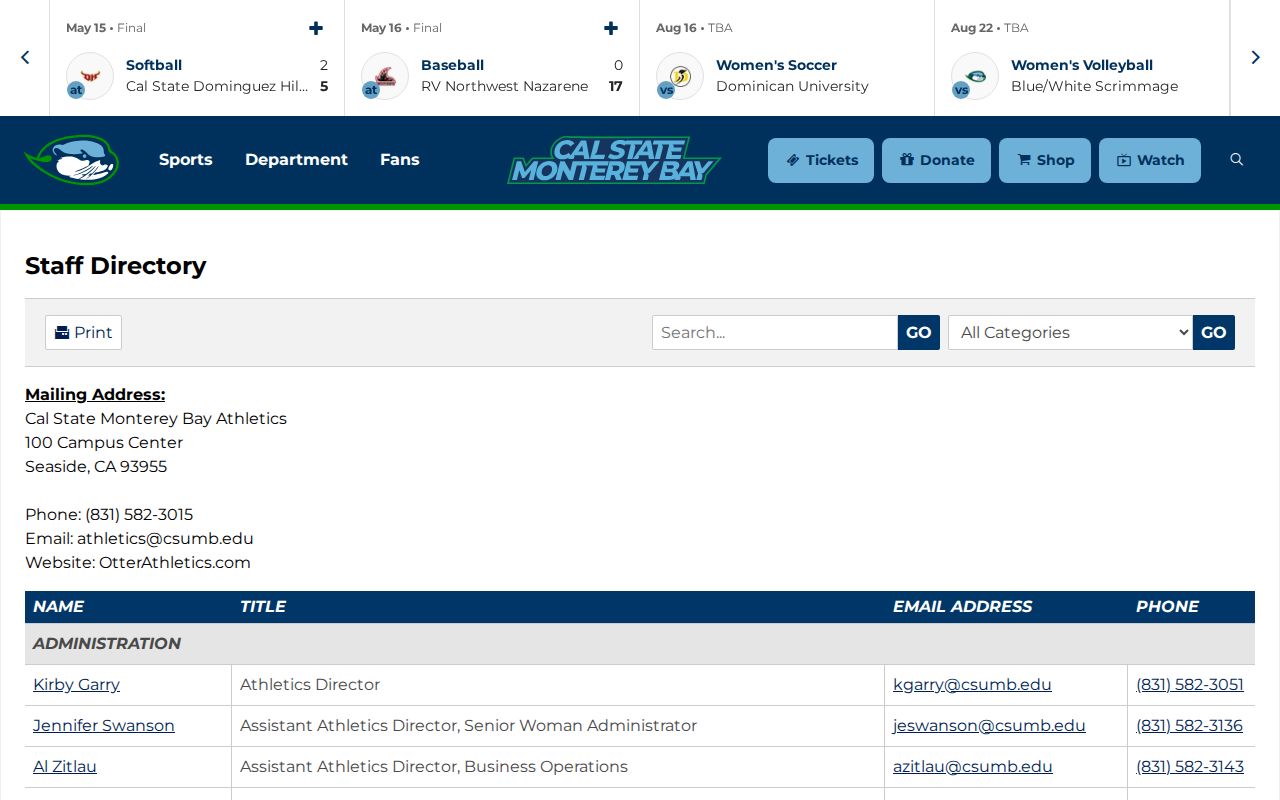
The screen makes the program filters visible before a user opens any staff entry, which helps when a surname alone is too broad.
The broader CSUMB directory page is the next stop for faculty and staff outside athletics.
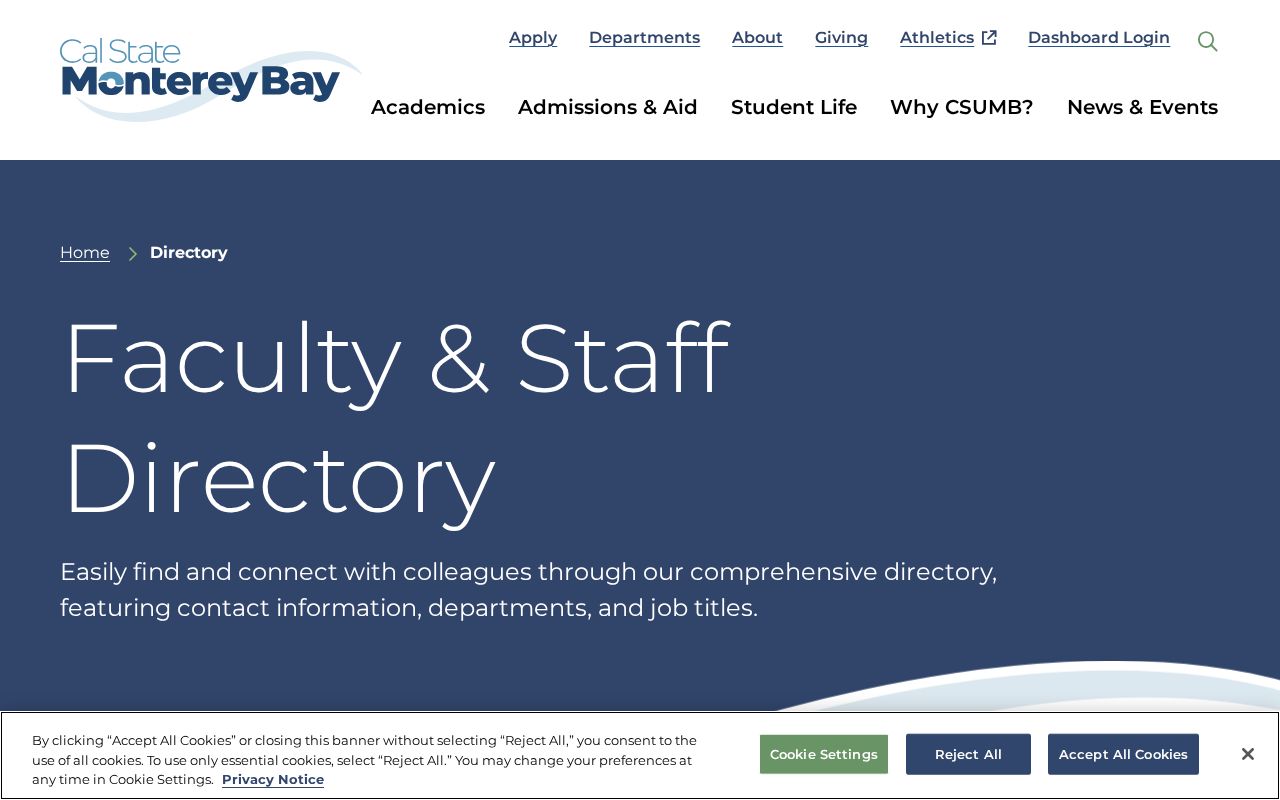
Its campus scope fills a local gap that city and district directories cannot cover.
Fort Ord Directories in Seaside
Fort Ord changes the geography of Seaside people directories. The former military reservation now connects local searches with CSUMB, the Central Coast Veterans Cemetery, redevelopment records, and military history. A name may therefore appear under a university campus address, a veterans resource, a federal military record, or a Monterey County archive even when the person lived near modern Seaside.
For a veteran, begin with official cemetery or federal grave resources and then compare county death records, obituaries, and local history files. Military discharge papers recorded with a county recorder are restricted, so they are not an open name directory. For a campus contact, use CSUMB's current directory. For a past Fort Ord resident, library and historical society collections are more likely to help than a city staff page.
Note: A Seaside mailing address near former Fort Ord does not always identify the agency or city jurisdiction that keeps the record.
Browse Seaside Property Directories
Monterey County property systems resemble owner directories, but the public online route is parcel-first. The Assessor Property Inquiry accepts a Fee Parcel number or Assessment Number. The county says the result can show ownership, parcel status, tax rate area, assessed values, exemptions, and parcel characteristics. It also says public web searches are not available by owner name or address.
The Parcel Report Web App adds parcel address, land use, zoning, hazards, habitats, and historical-resource context. A parcel number can then lead to the recorder's grantor and grantee index, where document parties form a name directory of transfers and liens. Exact access rules and copy procedures belong with Seaside public records.
Parcel-first limit. Do not expect the Monterey County assessor page to browse Seaside owners by name or street address. Obtain the parcel identifier first.
Search Seaside Government Directories
The Seaside staff directory searches first name and last name or browses a category. Categories include the City Clerk, Planning Division, Building and Code Enforcement, Public Works and Engineering, Finance, Fire, Police, Recreation, and boards and commissions. It is both a people directory and a route to the office that can answer a records question.
| Name | Given name and surname on listed staff entries |
|---|---|
| Role | Title and department or program unit |
| Contact | Department or individual phone, with email on some pages |
| Place | Physical address and, when listed, a separate mailing address |
| Extra detail | Fax, hours, or an additional phone when the unit publishes it |
Monterey County did not yield one county-wide employee directory in the research. Use its department pages instead. At state level, the California Personnel Office Directory lists personnel-office contacts and department addresses rather than every state worker. The State Controller's directory page is the official entry point.
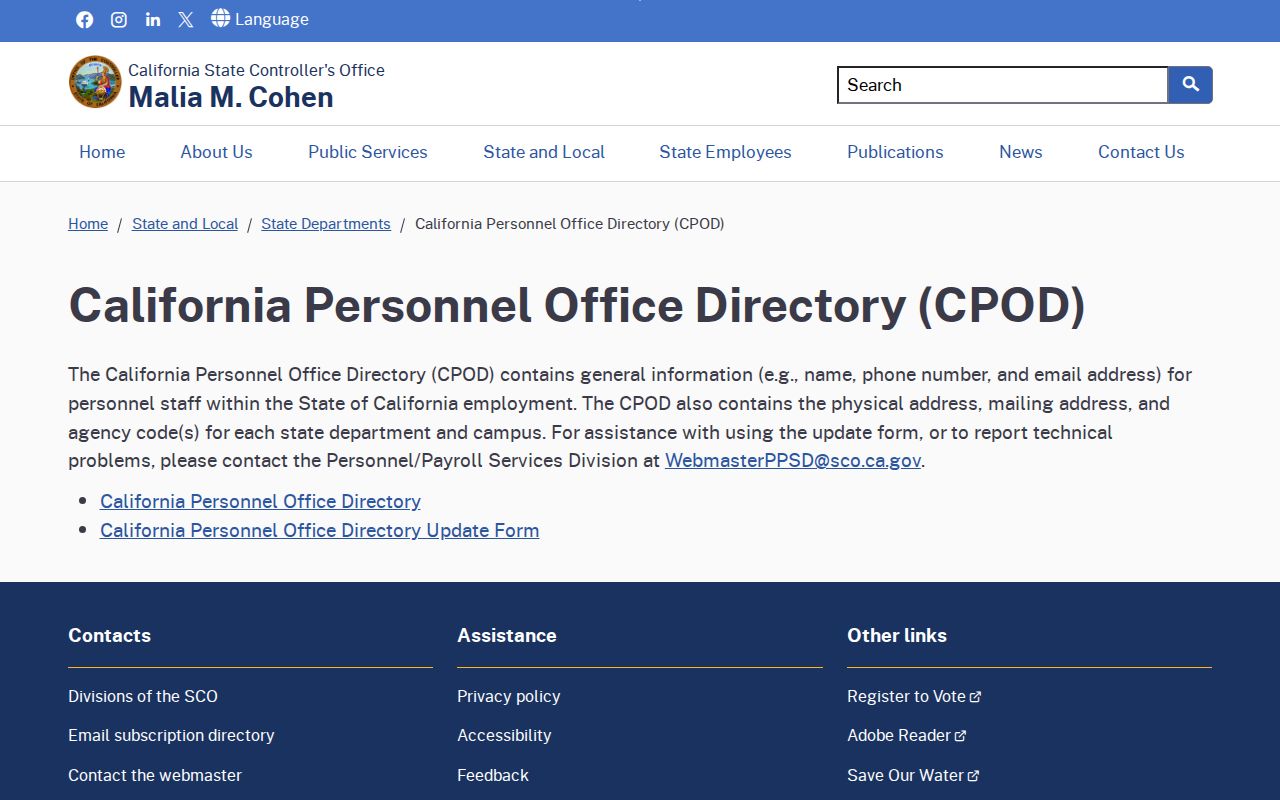
This state directory is best when a Seaside inquiry needs an agency personnel office, department code, phone, email, or mailing address.
Seaside License and Business Directories
State filing and license systems are useful people directories when a name is tied to a trade or business. The California DCA License Search reports whether a covered license is current, expired, suspended, revoked, or linked to public discipline. Board-specific tools can add detail for contractors, attorneys, real estate licensees, teachers, medical professionals, nurses, and other regulated fields.
The California Secretary of State business search covers corporations, limited liability companies, limited partnerships, agents, and filed documents. Its UCC index can be searched by debtor name, secured-party name, or file number. Seaside also requires local business licenses, but the official city pages do not expose a browseable license register. Ask the city for a record by business name, person, or address when state directories do not settle the question.
Note: A license directory verifies the public record kept by its board; it does not prove that every person using a trade name is listed there.
Seaside Court and Recorder Directories
Two official indexes turn events into name directories. Monterey Superior Court accepts party and business searches for current and completed cases dating back to 2008. Results connect a name with a case number, type, and scheduled hearing, subject to sealed and confidential record limits. Older non-confidential files move outside that web directory to the Monterey County Historical Society.
The Monterey County Clerk-Recorder Tyler index organizes parties to deeds, liens, and other recorded documents. Its own disclaimer compares the index to a library card catalog. It is a guide to the underlying record, not the record itself. Search every reasonable spelling variant, then use a document number or book and page to request the actual image or copy. Grantor means a party giving an interest; grantee means a party receiving it.
Neither index is a full list of Seaside residents. Each lists a person only when a court or recorded event created an entry.
Seaside Library Name Directories
Monterey County Free Libraries holds the best documented local mix for older Seaside searches. Its genealogy and family history resources include Monterey city and county directories, microfilm, a Californiana collection by appointment, biographies and obituaries by request, and a newspaper clippings file by request. Those channels matter because much of the useful material is not a public name box on the web.
Monterey Public Library's California History Room adds reference-only books, manuscripts, periodicals, and clippings. Its Monterey County Herald obituary index has cataloged holdings for 1993 through 1996 and 1997 through October 1999. The county library's digital collection contains books, maps, photographs, and documents spanning regional history from the 1890s to the 1970s.
MCFL local history
Directories, microfilm, obituaries, biographies, clippings, maps, and appointment collections.
California History Room
Reference-only regional books, manuscripts, periodicals, audiovisual items, and obituary indexing.
Historical Society
Older court files plus land, military, immigration, and Mexican-era archival records.
The Seaside Branch itself grew from the Emerson Library Club in 1931, followed by a voter-approved bond for a new library in 1968. That history helps explain why Seaside directory research now runs through the county library network rather than a separate city archive.
Trace Seaside Historical Directories
Historical Seaside people directories often sit inside regional runs labeled Monterey, Pacific Grove, or Salinas. Known catalog leads include a Seaside City Directory from 1957, Monterey and San Benito telephone books from February 1941 through August 1961, and regional city directories that include Seaside with nearby communities. Carmel's official local-history information identifies directories from 1947 through 1960, with some gaps, that list Seaside residents as part of the regional set.
A reverse directory starts with a street address and identifies the listed occupant. A standard city directory begins with a name and may add an address, occupation, spouse, or business. The California State Library says its city and county directory collection covers every California county, though most volumes are not online. Its holdings database can identify a useful year before a visit or reference request.
- City directory
- A dated list of residents and businesses, usually arranged by surname.
- Reverse directory
- An address-first list used to identify who was listed at a property in a given year.
- Telephone book
- A subscriber list that may include a name, number, and service address.
- Yearbook
- A school record that can place a student or faculty member in a specific school year.
Compare adjacent volumes and a census year rather than treating one entry as final. For a deceased resident, pair the directory with the Herald obituary index, probate files, a death certificate, or an official cemetery inquiry. Fort Ord-era names may be filed under military or regional geography instead of Seaside.
Note: Exact reverse-directory years were not confirmed, so ask the library to check its holdings before planning a visit.
Seaside Directories With Access Limits
Some lists exist but are not open people directories. California voter registration files are confidential and released only for electoral, scholarly, journalistic, political, or governmental purposes allowed by law. They cannot be browsed as a general resident list. School pages publish current staff contacts, not student records. Recorded military discharge documents also have access limits.
Seaside business-license records exist because city businesses must be licensed, yet no public browseable register appeared in the official research. Community groups, alumni rosters, and local chamber contacts were also not verified as complete official directories. Use the stated custodian or library fallback instead of assuming a missing web result means no record exists.
Use directory data lawfully. Do not use a public contact, address, archive entry, or record index to stalk, harass, threaten, or harm another person.